
 Explore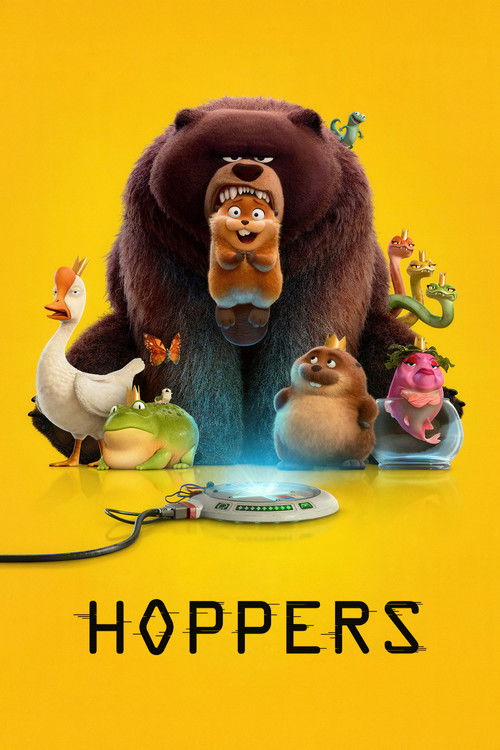
Movie2026
Hoppers
Scientists have discovered how to 'hop' human consciousness into lifelike robotic animals, allowing people to communicate with animals as animals. Animal lover Mabel seizes an opportunity to use the technology, uncovering mysteries within the animal world beyond anything she could have imagined.
Reviews
4.26 ratings
4.5
The film's central reveal is that Mabel does not merely visit the animal world through a harmless machine. Her consciousness is copied into the robotic beaver body while the original version of her remains sedated in the lab, and the company quietly keeps both versions alive long enough to compare their behaviour. That changes the early comedy completely. The little pauses where the beaver seems confused are not cute calibration errors; they are moments in which the copied Mabel realises that her memories feel real even though she may not be the person who made them. The movie hides that idea behind bright colours and quick jokes, then lets it surface in the quiet scene by the flooded burrow. I liked that the reveal never turns the story into grim science fiction. It stays emotionally readable for a family audience while still asking whether continuity, memory, or the body is what makes somebody themselves. Dr. Finch is initially framed as the obvious villain because he monitors every excursion and keeps erasing pieces of the field logs. The spoiler is that he has been leaving the gaps on purpose so the board cannot use the recordings to identify the wild animals that helped Mabel. His coldness is partly an act, and the locked archive contains failed transfer subjects rather than a secret weapon. The strongest scene is when Mabel finds the row of inactive shells and hears fragments of their final sensory recordings. Nothing jumps out, and nobody gives a speech. The soundtrack drops away, the reflected forest moves across their glass eyes, and she understands the cost before Finch confirms it. That restraint is much better than a loud twist. It also explains why he repeatedly tries to end the experiment even while appearing to push it forward. The family conflict lands because Mabel's mother already knows the transfer can create a second consciousness. She signed the original research agreement after being told the copy would last only a few seconds, then spent years convincing herself that no lasting person had been created. When the beaver version calls her by the childhood nickname used in the opening flashback, denial stops being possible. Their conversation through the habitat glass is the emotional centre of the film. The mother cannot decide which daughter deserves to wake up, and the script refuses to make that choice easy by presenting one version as fake or corrupted. Both remember the same promises. Both are scared. Both try to protect the other. For a film sold through slapstick animals, that is an unexpectedly humane dilemma. The dam sequence works because every running joke becomes practical without feeling like a checklist. The obsessive wood collecting builds the emergency barrier, the squirrel's stolen access cards open the service tunnel, and the bear's fear of enclosed spaces matters when he has to carry the backup battery underground. Mabel does not suddenly become an action hero. She succeeds because she has paid attention to how each animal moves and what each one needs. The flood is also caused by the company trying to flush the habitat before regulators arrive, not by a random storm, so the climax grows directly from the cover-up. The visual gag in which dozens of tiny tracking tags blink beneath the water is funny for one second and then horrifying once their purpose becomes clear. I was especially glad the film did not solve the identity problem by merging the two Mabels into one convenient person. The human Mabel wakes and chooses to testify, while the beaver Mabel refuses a destructive transfer back into the original body. She says that returning would not send her home; it would only create another copy and kill the person speaking. That line is the thematic point of the story, and it gives the animal version agency instead of treating her as temporary data. The farewell between the two Mabels is understated. They compare one memory and notice a tiny difference in the colour of a bedroom wall, proof that they have already begun becoming separate people. It is a simple detail, but it makes the science-fiction premise feel personal. The ending is hopeful without pretending the consequences disappear. Finch releases the research, the board members are arrested, and the sanctuary becomes independent, but the surviving transfer subjects still need bodies, care, and legal recognition. Mabel's final video does not announce that everything is fixed. She asks viewers to stop calling the copies experiments and starts listing their chosen names. During the credits, short scenes show the sanctuary adapting ordinary spaces: lower door handles, water-safe tablets, wide paths, and a classroom where humans and animals learn the same sign system. The last shot returns to the burrow, where Mabel hears her mother reading outside and chooses to stay with her new community for the night. It is warm, a little strange, and earned. Because the movie reveals these ideas gradually, a second viewing improves the first half. Finch always speaks to the beaver at eye level. The mother's messages avoid saying whether she is talking to the body in the lab or the consciousness in the field. Even the cheerful orientation video uses the phrase 'temporary behavioural instance' instead of 'you.' Those details are not there simply to prove the writers planned the twist; they show how institutions use careful language to avoid recognising harm. The comedy keeps the film buoyant, but the craft underneath it is precise. The performances also help. Mabel's voice becomes steadier after the archive scene without losing the restless energy that made her funny, and Finch's clipped delivery softens only after his motive is exposed. My main reservation is that the board members remain flatter than the rest of the cast. Their greed is believable, but the film gives them none of the conflicted reasoning offered to Finch or Mabel's mother. A longer scene about why the company believes copies are disposable could have made the final hearing sharper. Still, the story understands that an antagonist does not need a tragic childhood when the real threat is a system designed to turn living experience into property. The hearing works because the evidence comes from the animals' own recordings rather than a last-minute confession. Mabel wins by making their perspective impossible to edit out. The spoiler-heavy version of my verdict is that Hoppers succeeds because its twist changes the meaning of the relationship rather than merely changing the plot. Mabel's journey begins as an escape into another body and ends with her accepting that the other body now belongs to someone real. Her mother begins by wanting one daughter restored and ends by learning to love two people whose shared past does not make either of them less complete. Finch begins as a gatekeeper and ends as a witness who finally gives up control of the work. Those arcs meet cleanly at the sanctuary without becoming too neat. The film remains funny, colourful, and accessible, yet it trusts younger viewers with uncertainty. That trust is what stayed with me after the credits. The film's central reveal is that Mabel does not merely visit the animal world through a harmless machine. Her consciousness is copied into the robotic beaver body while the original version of her remains sedated in the lab, and the company quietly keeps both versions alive long enough to compare their behaviour. That changes the early comedy completely. The little pauses where the beaver seems confused are not cute calibration errors; they are moments in which the copied Mabel realises that her memories feel real even though she may not be the person who made them. The movie hides that idea behind bright colours and quick jokes, then lets it surface in the quiet scene by the flooded burrow. I liked that the reveal never turns the story into grim science fiction. It stays emotionally readable for a family audience while still asking whether continuity, memory, or the body is what makes somebody themselves. Dr. Finch is initially framed as the obvious villain because he monitors every excursion and keeps erasing pieces of the field logs. The spoiler is that he has been leaving the gaps on purpose so the board cannot use the recordings to identify the wild animals that helped Mabel. His coldness is partly an act, and the locked archive contains failed transfer subjects rather than a secret weapon. The strongest scene is when Mabel finds the row of inactive shells and hears fragments of their final sensory recordings. Nothing jumps out, and nobody gives a speech. The soundtrack drops away, the reflected forest moves across their glass eyes, and she understands the cost before Finch confirms it. That restraint is much better than a loud twist. It also explains why he repeatedly tries to end the experiment even while appearing to push it forward. The family conflict lands because Mabel's mother already knows the transfer can create a second consciousness. She signed the original research agreement after being told the copy would last only a few seconds, then spent years convincing herself that no lasting person had been created. When the beaver version calls her by the childhood nickname used in the opening flashback, denial stops being possible. Their conversation through the habitat glass is the emotional centre of the film. The mother cannot decide which daughter deserves to wake up, and the script refuses to make that choice easy by presenting one version as fake or corrupted. Both remember the same promises. Both are scared. Both try to protect the other. For a film sold through slapstick animals, that is an unexpectedly humane dilemma. The dam sequence works because every running joke becomes practical without feeling like a checklist. The obsessive wood collecting builds the emergency barrier, the squirrel's That is why the reveal works: it makes every quiet choice before it feel newly alive.
4.0
Bright, strange, and much funnier than the premise sounded on paper. The visual comedy is excellent, especially whenever the film lets an animal react in the background instead of cutting to a punchline. The story is familiar, but the rhythm and craft make it feel fresh.
4.5
The reveal that Dr. Finch has been hearing fragments of the animal network all along reframes his early awkwardness without turning him into a secret villain. I liked that choice. The final act becomes less about beating him and more about deciding who gets to speak for the forest. Mabel destroying the translator looks like a simple heroic sacrifice at first, but the last scene complicates it: the beavers rebuild a smaller version from pieces they saved, and this time they decide when it turns on. That lands the movie's point far better than a speech would. Even the running acorn joke pays off when the stash blocks the logging machine. The only weak beat is how quickly the company abandons the project after the livestream; the film earns its emotional resolution more than its practical one. Still, the ending feels generous rather than neat, and the quiet shot of Mabel listening without technology is a lovely final image.
3.5
The creek rescue works because Mabel finally stops controlling the beavers and trusts them to lead her home.
4.0
I expected the body-swap premise to do most of the work, but Hoppers is better when it slows down and lets its world breathe. The forest feels busy without becoming noisy: fur catches the light differently from leaves, background animals keep living when the camera moves away, and the sound design makes every burrow feel inhabited. The comedy is quick, but it rarely undercuts the emotional beats. What stayed with me most was how gently the film treats curiosity. It does not frame wonder as something childish that Mabel has to outgrow; it lets wonder become the reason she pays closer attention. A few of the middle scenes repeat the same point, yet the warmth of the characters and the precision of the animation carried me through. It is polished, funny, and unexpectedly sincere without begging to be called important.
4.5
Tiny movie, huge heart. The animation feels wonderfully tactile, and the jokes never crowd out the quieter beats.